Biogenic Carbon Sequestration & CBAM Mitigation: The Role of Palm Stick Brooms in Manufacturing Decarbonization
In the era of global carbon taxes and the implementation of Carbon Border Adjustment Mechanism (CBAM) regulations, the international manufacturing industry is required to cut the embodied carbon footprint in every raw material they import. The use of artificial polymer synthetic fibers adds a burden of fossil carbon emissions to your company’s sustainability balance sheet, leading to potential carbon tax fines at the port of import destination.
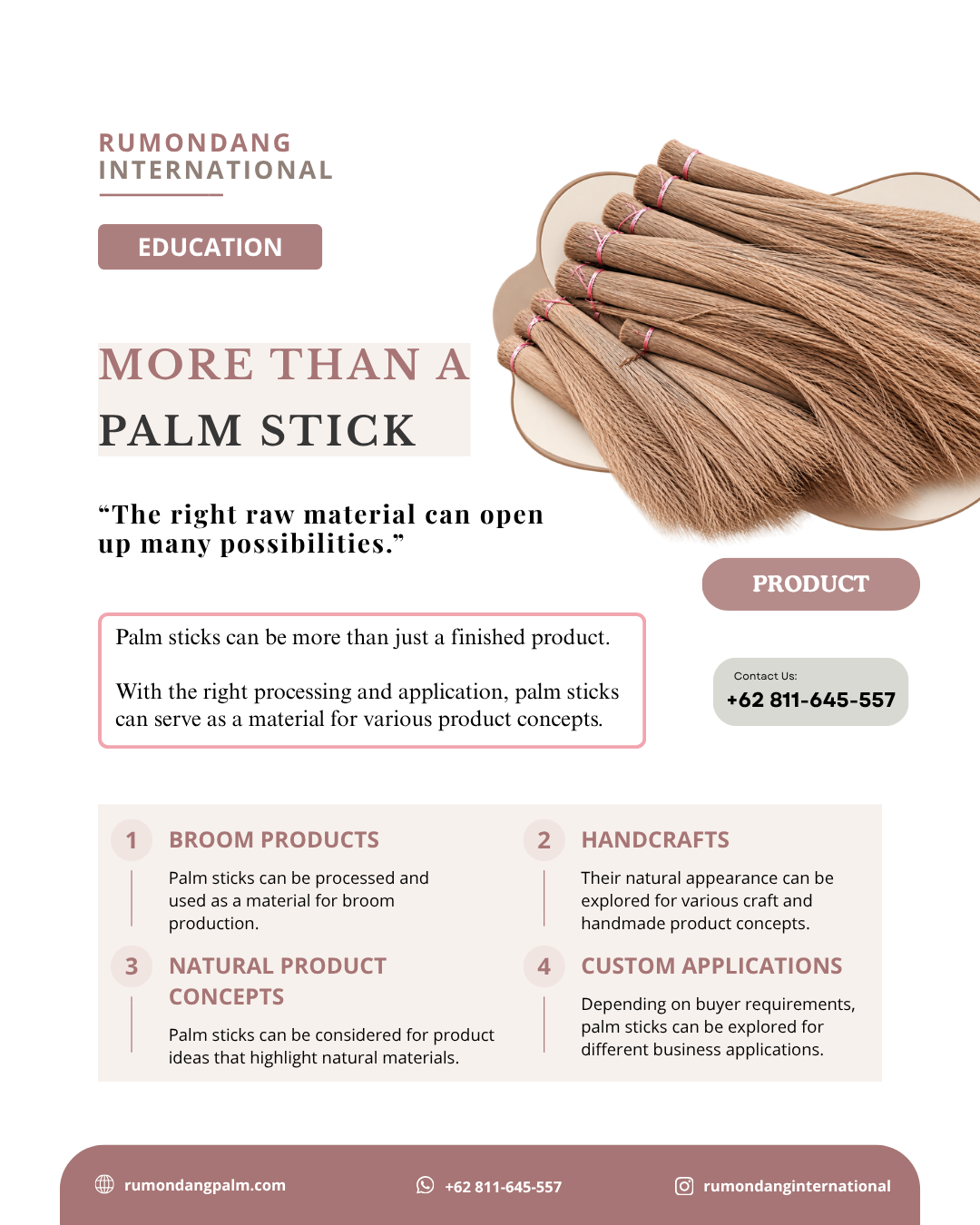
Ignoring the intensity of carbon emissions in cleaning tools can reduce the price competitiveness of your final product due to the high international carbon levy.
As a direct factory-based Indonesian Palm Stick Broom Supplier, Rumondang Palm supplies palm sticks (palm skewers) that guide the concept of Biogenic Carbon Sequestration. Our palm skewers absorb CO₂ from the atmosphere during the growth period of the palm tree and store it stably in a wood lignin matrix, providing a carbon-neutral footprint value that helps minimize your company’s CBAM carbon tax risk.
The following is a comparative analysis of the contribution of biogenic carbon sequestration and emission accounting efficiency from palm stick broom to support your company’s supply chain decarbonization strategy.
How Does Biogenic Carbon Palm Skewers Help Mitigate Carbon Taxes?
Direct Answer:
Biogenic carbon palm stick broom helps mitigate carbon taxes because it stores naturally absorbed atmospheric CO₂ during photosynthesis, so it is categorized as a carbon-neutral feedstock in CBAM’s emissions accounting report.
Carbon Evaluation Matrix: Synthetic Plastic Fiber vs. Direct Factory Rumondang Palm
The table below analyzes a comparison of the emission profiles and carbon tax implications of different types of industrial broom feedstocks:
| Carbon Footprint & CBAM Indicators | Synthetic Plastic Fiber (PP/PET) | Biomaterial Palm Stick Broom (Rumondang Palm) | Impact on B2B Carbon Tax Costs |
| Carbon Origin Category | Fossil-Based Carbon | Renewable Biogenic Carbon | Recognized as an environmentally friendly renewable material. |
| Emission Intensity ($\text{kg CO}_2\text{e} / \text{kg}$) | Height ($> 2.5 – 3.8\text{ kg CO}_2\text{e}$) | Close to Neutral ($\approx 0\text{ Net Emissions}$) | Minimize the burden of CBAM import tax fines. |
| Carbon Bonded Storage (Sequestration) | None (Releases emissions when produced) | Storing Permanent Atmospheric Carbon | Improve the Scope 3 Emissions accounting score. |
| European/US Import Regulation Compliance | Subject to additional fossil emission levy | Meeting Global Decarbonization Standards | Maintain product price margins in the international market. |
“Manufacturing decarbonization starts from the selection of raw materials that have a net biogenic carbon footprint. We present Indonesian palm skewers as a low-carbon material solution that is ready to protect partner businesses from global carbon tax risks.”
— Decarbonization & Carbon Accounting Advisory Team Rumondang Palm
3 Pillars of Carbon Accounting Rumondang Palm
-
Natural Carbon Sink (Biogenic Carbon Sink): Every kilogram of palm skewers locks in carbon absorbed from the air without going through the process of fossil-fueled chemical synthesis.
-
Low-Carbon Processing: Our mills rely on mechanical separation and calibrated drying to keep manufacturing emissions to a minimum.
-
Verified Emission Data Sheet Certification: We provide biogenic carbon emissions balance documentation to support your company’s green claims reporting.
Access to Rumondang Palm Ecosystem Information
Learn more about our manufacturing capabilities and export standards compliance through the following internal references:
-
Main Pillar Page: An overview of manufacturing capacity in Palm Stick Broom Supplier Indonesia.
-
Fire Safety & Flammability: Review thermal safety analysis in Fire Safety & Thermal Flammability Standards for Palm Stick Broom.
-
Climate Resilience & Climate Adaptation: Review the durability of the material in Climate Resilience & Weather Adaptation Standards for Palm Stick Broom.
FAQs
Why are palm skewers categorized as carbon-neutral?
This is because the CO₂ released at the end of the life of palm skewers is equal to the amount of CO₂ absorbed by oil palm trees during their natural growth process.
How do Rumondang Palm palm skewers help our company’s Scope 3 emissions reporting?
Our palm skewers have a much lower embodied carbon emission intensity than artificial polymer fibres, automatically lowering your total Scope 3 Category 1 (Purchased Goods) emissions.
Realizing Low-Carbon Manufacturing with Rumondang Palm
Strengthen your decarbonization strategy and protect your company’s supply chain from carbon tax fines by adopting high-quality palm stick broom raw materials.
Contact our team of sustainability and carbon accounting specialists to obtain Biogenic Carbon Data Sheets, emissions reports and samples of natural products.
Copyright © 2019 Rumondang Palm. All Rights Reserved. or Inquiry Carbon Accounting & CBAM Data Sheet
1 Comment
[…] Carbon Absorption & CBAM Mitigation: Review biogenic carbon analysis in Biogenic Carbon Sequestration & CBAM Standards for Palm Stick Broom. […]